
Milestones · 0–12 months

Your baby's first year

The first year is where communication begins, long before words arrive. Eye contact, babbling and gestures are the foundation everything else builds on.

No referral needed to chat · Most evaluations booked within a week

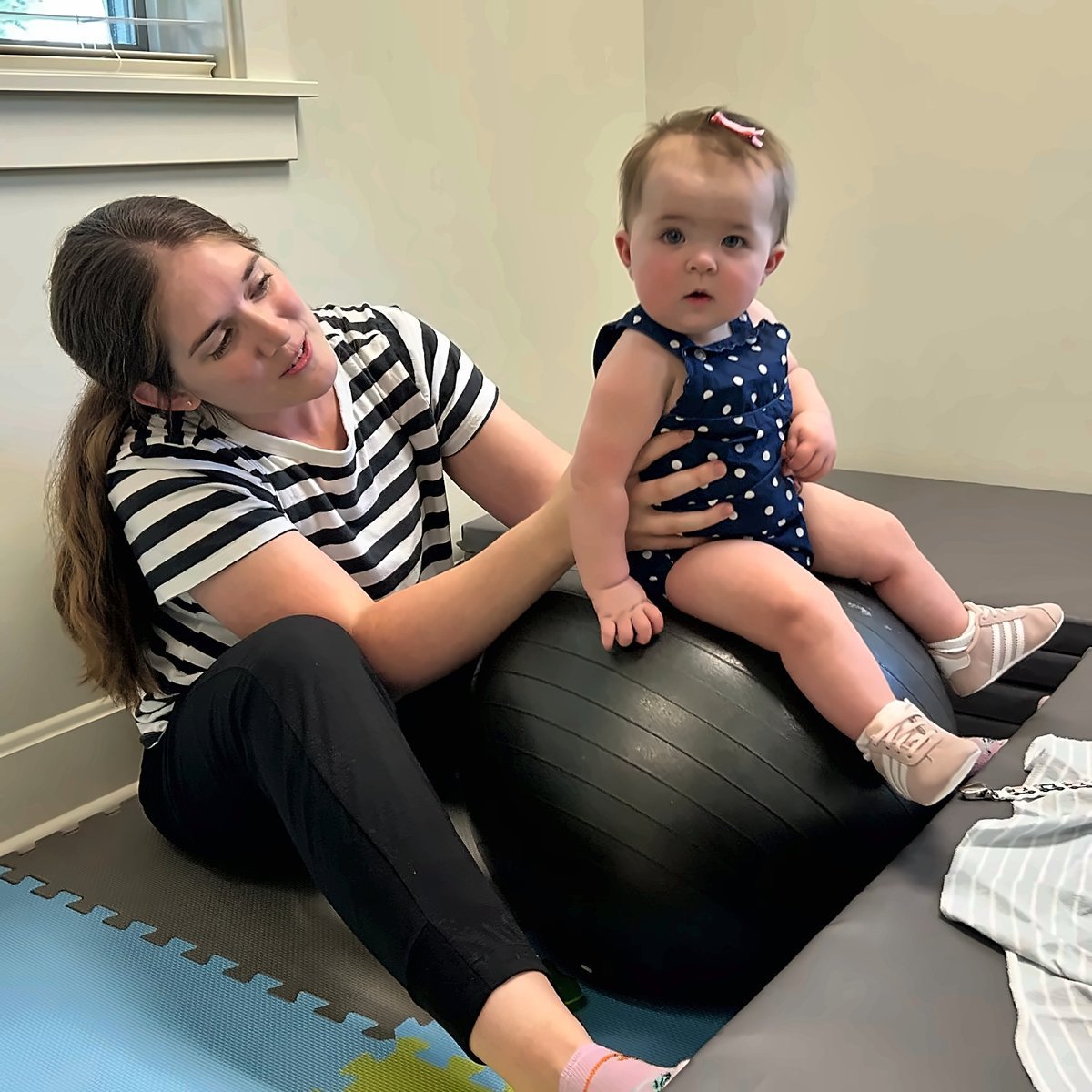
Woman in striped shirt sitting on exercise ball with toddler in navy polka dot outfit on a padded floor
Birth to 12 months

What most infants can do

Every baby gets there on their own schedule. These are the skills all five of our therapists watch for, grouped by month, so you can read straight down to your baby's age.

Speech Therapy

How children understand, use, and share language with others

Birth–3 months

  • Reacts to sounds and turns toward voices
  • Calms or smiles when you talk
  • Coos ("ooh," "aah") and makes different sounds when happy or upset

4–6 months

  • Giggles and laughs
  • Plays with vowel sounds, sometimes mixed with consonants ("ah-goo")
  • Blows raspberries and notices toys that make sounds

7–9 months

  • Looks at you when you call their name
  • Babbles long strings like "bababa" or "mamama"
  • Raises arms to be picked up and pauses when you say "no"

10–12 months

  • Points, waves, and shows or hands you things
  • Tries to copy sounds you make
  • Understands simple phrases like "go bye-bye"
  • Says one or two words, like "mama," "dada," "hi" or "bye"
About Speech Therapy

Occupational Therapy

Fine motor, sensory, self-care and play skills for everyday life

0–7 months

  • Brings hands to mouth
  • Holds a bottle
  • Looks at toys when holding them
  • Tolerates loud noises

7–12 months

  • Begins letting go of toys purposely
  • Bangs toys together at midline
  • Explores different textures
  • Uses hands to "rake" small objects
  • Transfers objects from hand to hand
About Occupational Therapy

Physical Therapy

Big movement, strength, balance and coordination

0–3 months

  • Grasp is reflexive
  • Turns head to both sides while on back
  • Visually tracks objects
  • Tummy time toleration, attempts to lift head

3–5 months

  • Holds head up when in sitting
  • Rolls front to back
  • Head control when held in sitting
  • Grasp is purposeful, brings objects to mouth

6–9 months

  • Sits without support
  • Rolls back to front
  • Bears weight on legs when supported
  • Transfers objects hand to hand
  • Feet to mouth

10–12 months

  • Crawls on hands and knees
  • Pulls to stand
  • Cruises along furniture
  • Stands unsupported
About Physical Therapy

Feeding Therapy

Chewing, swallowing, textures and calmer mealtimes

0–6 months

  • Latches and feeds comfortably at breast or bottle
  • Coordinates suck, swallow and breathe without coughing or gulping
  • Brings hands and safe toys to their mouth for exploration
  • Settles and stays calm through a feed

6–9 months

  • Shows interest in food and opens mouth for a spoon (about 6 months)
  • Moves from smooth purees to soft lumps without gagging
  • Begins to close lips around the spoon and pull food off
  • Brings hands and safe toys to their mouth for exploration

9–12 months

  • Manages soft lumps and early finger foods without gagging
  • Drinks from an open cup with help (about 9–12 months)
  • Begins to pick up small pieces of food and bring them to the mouth
  • Chews soft table foods, even without many teeth
About Feeding Therapy

Orofacial Myofunctional Therapy

Where the tongue, lips and jaw rest and how they move

Under 4

  • Thumb sucking, finger sucking and pacifier use are normal at this age
  • Mouth breathing during a cold, or while teething, is expected
  • The tongue rests forward in the mouth in infancy and settles back over the first years
  • This is the age we watch rather than treat — habits that stop on their own need nothing
  • If your dentist or pediatrician raises a concern early, we're happy to talk it through
About Orofacial Myofunctional Therapy

A note from our therapists: infants who were born early, had a NICU stay, or are working on feeding often reach these later; that's expected, and it isn't a reason to worry. It is a reason to ask.

These are general guidelines, not a diagnosis. Infants learn on a wide range of timelines: a baby who is a little behind on one skill is often right on track.

Communication milestones are adapted from the American Speech-Language-Hearing Association (ASHA). Gross motor and occupational therapy milestones are adapted from the clinic's own handouts. Each range shows when about 3 out of 4 children have the skill, so it’s normal for some children to reach it a little later. Look at the age ranges just before and after your child’s age too.

Worth a closer look

Trusting your gut is never overreacting.

In the first year, these are the patterns our therapists would want to hear about. None of them mean something is wrong. They just mean it's a good time to ask.

Early support in the first year is some of the most powerful work we do, because so much of the brain's wiring is still being laid down.

If any of this sounds familiar, ask us about it.

Signs to mention in the first year

  • Doesn't react to sounds or turn toward voices
  • Not babbling by about 9 months
  • Doesn't respond to their name by about 9 months
  • Not pointing, waving or using gestures by 12 months

If you have any concerns about how your baby hears, ask your pediatrician about a hearing check, hearing is the foundation for speech.

Most evaluations booked within a week

Their next milestone is closer than you think.

Call, text or send us a message and you'll talk with our office manager about what you're seeing and what support would look like, before anything is scheduled.