
Milestones · 5–13 years

Skills that carry into class

Milestones don't stop at five. Speech sounds should be fully clear, and language now underpins reading, writing and friendships.

No referral needed to chat · Most evaluations booked within a week

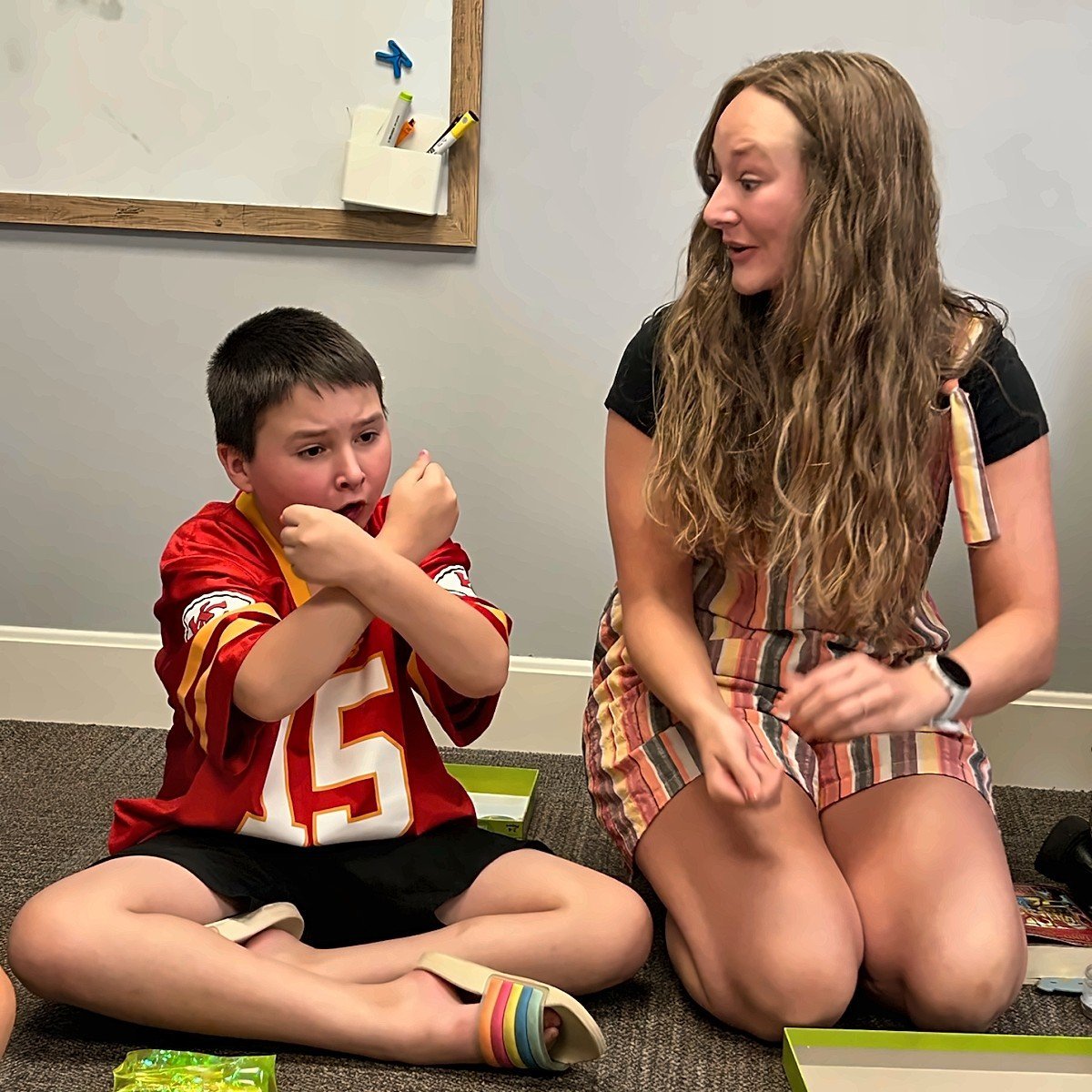
A young woman kneeling beside a young boy wearing a red sports jersey, engaging in conversation in an indoor classroom setting
Age 5 to 13

What most school-age kids can do

By school age, milestones stop being about firsts and start being about mastery, clear speech, confident reading, and the language behind friendships.

Speech Therapy

How children understand, use, and share language with others

5–13 years

  • Says nearly all speech sounds correctly and is easy to understand
  • Talks smoothly, without often repeating sounds or getting stuck on words
  • Follows classroom directions and understands lessons
  • Tells a story or explains an event in order, with detail
  • Uses language to make and keep friends
  • Reads with comprehension at grade level
  • Gets thoughts onto paper in a structured way
  • Uses language to negotiate, compromise and repair a conversation
About Speech Therapy

Occupational Therapy

Fine motor, sensory, self-care and play skills for everyday life

5–6 years

Dynamic tripod grasp

thumb, index and middle fingers with ring and pinky curled into palm; movement comes from the fingertips

Throws at a target 5 feet away and hits it fairly consistently

Printing letters and numbers legibly

Dresses and puts on shoes/socks independently

6+ years

  • Writes legibly and keeps up with handwriting in class
  • Uses scissors, glue, buttons, zippers and utensils smoothly
  • Manages dressing, hygiene and daily routines independently
  • Organizes homework and follows multi-step directions
  • Starts a task, sticks with it, and asks for help when stuck
  • Handles changes in routine without falling apart
About Occupational Therapy

Physical Therapy

Big movement, strength, balance and coordination

5+ years

  • Rides a two-wheel bike
  • Balances on one foot with eyes closed for several seconds
  • Kicks a ball with aim and control
  • Keeps up with peers in PE, sports and playground games
  • Runs and plays for a sustained period without tiring quickly
About Physical Therapy

Feeding Therapy

Chewing, swallowing, textures and calmer mealtimes

5–13 years

  • Chews and swallows safely and efficiently
  • Manages a school lunch and a packed lunch away from home
  • Handles mixed and unfamiliar foods at a friend's house or a restaurant
  • Takes bites and closes lips around the fork or spoon
  • Drinks enough through the day without reminders
  • Mealtimes are not a battleground for the family
About Feeding Therapy

Orofacial Myofunctional Therapy

Where the tongue, lips and jaw rest and how they move

4–6 years

  • Tongue rests on the roof of the mouth, not against or between the teeth
  • Lips are gently closed at rest, without effort
  • Breathing happens through the nose, including during sleep
  • Thumb, finger and pacifier habits have stopped
  • Swallowing happens without the tongue pushing forward against the front teeth
  • Speech sounds like "s," "z" and "th" are coming through clearly
  • Chewing happens with the lips closed

7–13 years

  • Nasal breathing continues at rest, during sleep and during focused activities
  • Tongue stays on the roof of the mouth while at rest and through the swallow
  • Lips stay closed at rest, even during screen time and reading
  • Sleep is restful — no snoring, no waking with a dry mouth
  • Chewing and swallowing are efficient and quiet
  • Orthodontic work is not being undermined by tongue or lip habits
About Orofacial Myofunctional Therapy

Speech sounds have a deadline

Most sounds are clear by 5 or 6, but a few (r, s, th, l) are expected to settle by about 7 to 8. Past that window, a sound that “might fix itself” usually won't on its own, and it gets harder to change once the habit is set.

“Doing fine” can still mean struggling

Plenty of children hold it together all day at school and fall apart at home. If homework takes three times as long as it should, or reading is a fight every night, that's worth looking into, even when report cards look okay.

These are general guidelines, not a diagnosis. Kids learn on a wide range of timelines: a child who is a little behind on one skill is often right on track.

Speech sound guidance is based on Crowe & McLeod (2020), American Journal of Speech-Language Pathology. Other milestones reflect the experience of our speech, occupational and physical therapists.

Worth a closer look

Trusting your gut is never overreacting.

Between ages 5 and 13, these are the patterns our therapists would want to hear about. None of them mean something is wrong. They just mean it's a good time to ask.

Getting in touch is exactly that: a conversation about what you're noticing. You don't need a referral to talk have it.

If any of this sounds familiar, ask us about it.

Signs to mention at 5–13 years

  • Speech sounds still unclear past age 7–8
  • Reading or writing well below grade level
  • Trouble following multi-step directions or organizing work
  • Difficulty with peer relationships or social language
  • Stuttering that persists or causes avoidance
Most evaluations booked within a week

Their next milestone is closer than you think.

Call, text or send us a message and you'll talk with our office manager about what you're seeing and what support would look like, before anything is scheduled.