
Milestones · 1–3 years

Words, walking and wanting

This is the age parents ask about most. Vocabulary takes off, little bodies get busy, and frustration often shows up when a child can't yet say what they mean.

No referral needed to chat · Most evaluations booked within a week

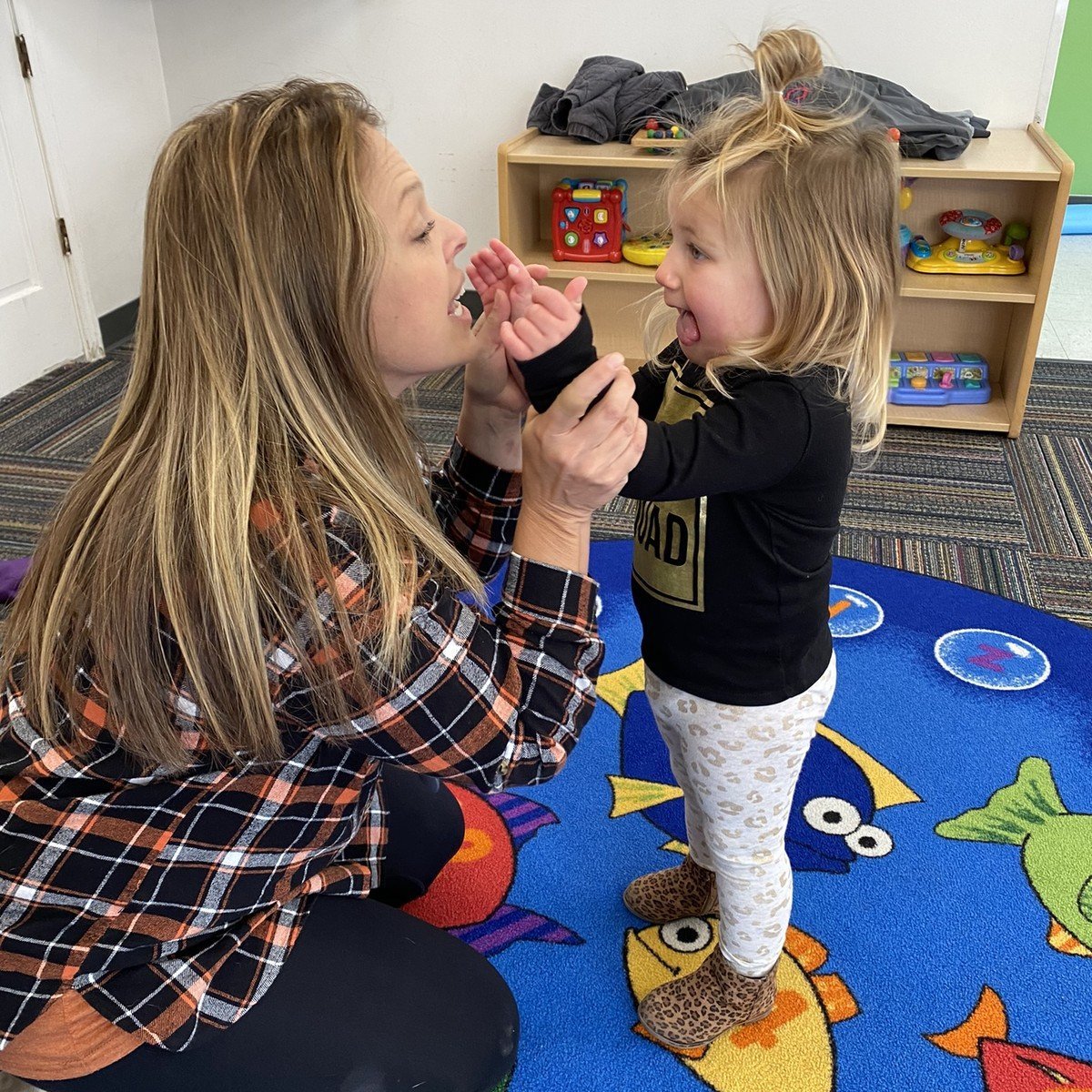
Woman and toddler playing with toy food in a colorful classroom setting with shelving and toys in background
Age 1 to 3

What most toddlers can do

Toddler skills arrive in bursts: a child can seem stuck for weeks and then do three new things in a day. These are the skills our therapists watch for.

Speech Therapy

How children understand, use, and share language with others

13–18 months

  • Follows simple directions, like "give me the ball" or "show me your nose"
  • Points to ask for things, show you something, or get information
  • Shakes head "no" and nods "yes"
  • Understands and uses words for familiar people, objects and some actions
  • Points to at least one body part when asked

19–24 months

  • Uses and understands at least 50 words for food, toys, animals and body parts (some may not sound clear yet, like "du" for shoe)
  • Puts two or more words together, like "more juice" or "go outside"
  • Follows two-step directions, like "get your cup and bring it to me"
  • Uses words like "me," "mine" and "help"

2–3 years

  • Combines words often, and may sometimes repeat a word or phrase while getting started
  • Asks "why" and "how" questions
  • Says their own name when asked
  • Uses plurals like "toys" and action words like "running"
  • Says p, b, m, h, w, d and n clearly
  • Speech is getting clearer, though people outside the family may not understand everything yet
About Speech Therapy

Occupational Therapy

Fine motor, sensory, self-care and play skills for everyday life

1–2 years

  • Uses a spoon; holds a cup
  • Scribbles
  • Takes off socks and shoes
  • Sorts shapes
  • Puts small items into containers

2–3 years

  • Snips with scissors
  • Imitates horizontal, vertical lines, and circular marks
  • Able to remove elastic-waist pants
  • Builds at least a 6-block tower
  • Eats all food textures
  • Unscrews lids
About Occupational Therapy

Physical Therapy

Big movement, strength, balance and coordination

12–15 months

  • Walks independently
  • Squats to floor and returns to stand
  • Throws a ball with an overhand release

15–24 months

  • Run with a wide base of support
  • Walks up and down stairs with a hand held
  • Kicks a ball
  • Jumps with both feet

2–3 years

  • Walks up stairs alternating feet without support
  • Hops on one foot
  • Stands on one foot momentarily
  • Pedals a tricycle
  • Catches a large ball with arms extended
About Physical Therapy

Feeding Therapy

Chewing, swallowing, textures and calmer mealtimes

12–18 months

  • Feeds themselves with fingers, then a spoon
  • Drinks from a sippy cup, a straw and an open cup with some spills
  • Moves food around the mouth and handles mixed textures — a sandwich, noodle soup
  • Gradually accepts a wider range of colours, textures and temperatures

18–24 months

  • Chews on both sides of the mouth and swallows without food falling out
  • Drinks from a small open cup with very few spills
  • Uses a spoon with less spilling, and still uses fingers a lot
  • Handles lumps, mixed textures and firmer foods without gagging

2–3 years

  • Uses a fork and spoon, though often still with fingers
  • Chews tougher foods without gagging or choking
  • Tries and accepts new foods more readily than in the first year
  • Sits at the table through most of a family meal
About Feeding Therapy

Orofacial Myofunctional Therapy

Where the tongue, lips and jaw rest and how they move

Under 4

  • Thumb sucking, finger sucking and pacifier use are normal at this age
  • Mouth breathing during a cold, or while teething, is expected
  • The tongue rests forward in the mouth in infancy and settles back over the first years
  • This is the age we watch rather than treat — habits that stop on their own need nothing
  • If your dentist or pediatrician raises a concern early, we're happy to talk it through
About Orofacial Myofunctional Therapy

The most-asked question we get

“She understands everything, she just doesn't talk.” Understanding and speaking are two different skills, and they don't always develop together. If your toddler follows directions easily but isn't using words yet; that is worth a conversation. Not a reason to panic.

The wait-and-see window

You will hear “they'll grow out of it.” That is often true, but when it isn't, the months spent waiting are months of practice a child doesn't get back. Contacting us costs you nothing and settles the question.

These are general guidelines, not a diagnosis. Toddlers learn on a wide range of timelines: a child who is a little behind on one skill is often right on track.

Communication milestones are adapted from the American Speech-Language-Hearing Association (ASHA). Each range shows when about 3 out of 4 children have the skill, so it’s normal for some children to reach it a little later. Look at the age ranges just before and after your child’s age too.

Worth a closer look

Trusting your gut is never overreacting.

Between ages 1 and 3, these are the patterns our therapists would want to hear about. None of them mean something is wrong. They just mean it's a good time to ask.

Getting in touch is exactly that: a conversation about what you're noticing. You don't need a referral to get started talking. have it.

If any of this sounds familiar, ask us about it.

Signs to mention at 1–3 years

  • Not saying any words by 18 months
  • Not using about 50 words, or not combining two words, by age 2
  • Not pointing, waving, or using gestures to communicate
  • Not following simple directions by 18 months
  • Very limited diet, gagging, or refusing most textures
  • Melts down far more than peers at ordinary sounds, touch or changes
Most evaluations booked within a week

Their next milestone is closer than you think.

Call, text or send us a message and you'll talk with our office manager about what you're seeing and what support would look like, before anything is scheduled.