
Milestones · 3–5 years

Being understood

Speech should be clear to people outside the family by now. This is also when fine motor skills and early pre-reading take center stage.

No referral needed to chat · Most evaluations booked within a week

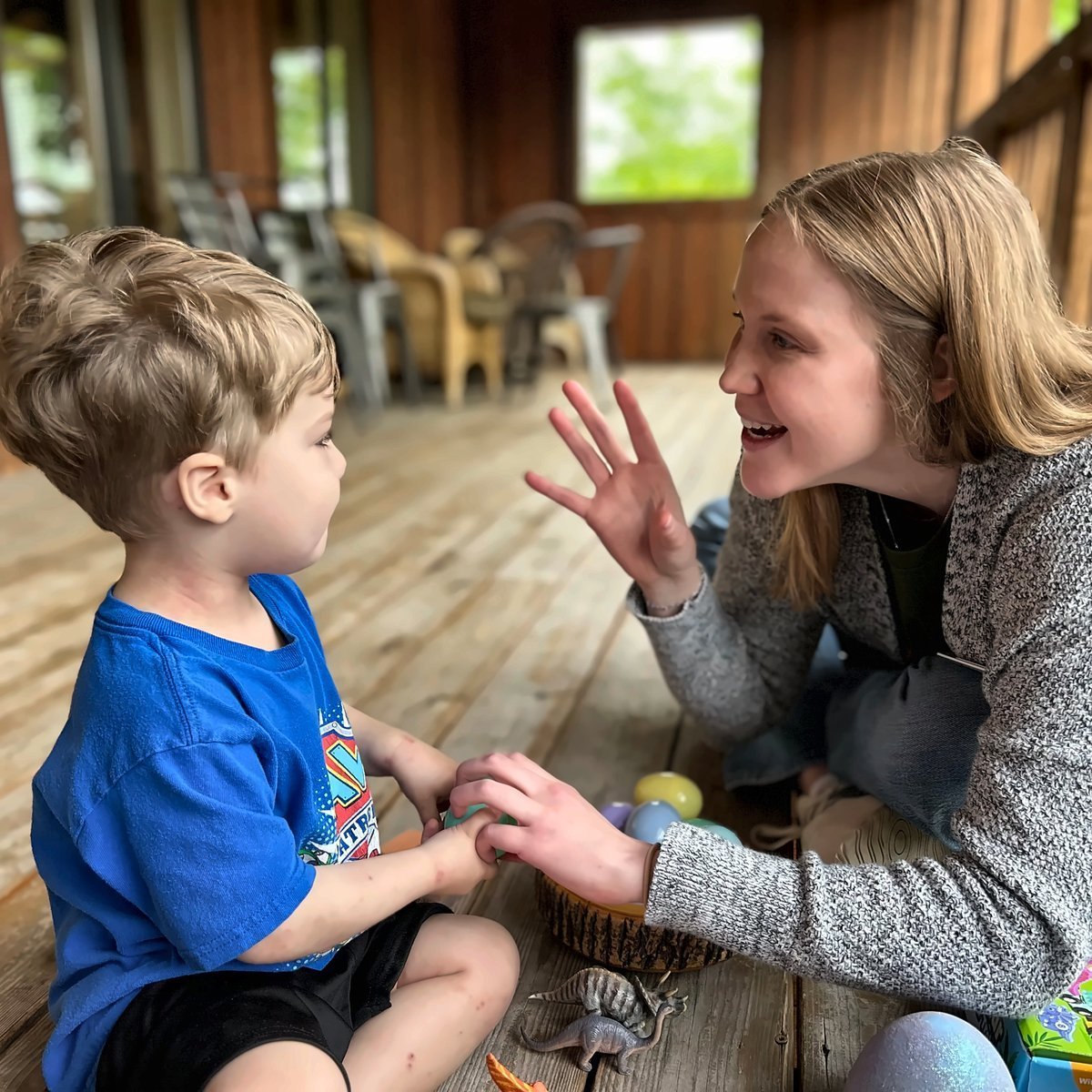
Woman in gray sweater smiling while interacting with young boy in blue shirt indoors on wooden floor
Age 3 to 5

What most preschoolers can do

Preschool is where early skills start to predict school. These are the ones our therapists watch for, across speech, movement and learning.

Speech Therapy

How children understand, use, and share language with others

3–4 years

  • Compares things using words like "bigger" or "shorter"
  • Retells a story from a book or show
  • Uses location words like "in," "on" and "under," and small words like "a" and "the"
  • Says t, k, g, f, y and "-ing" correctly in words
  • Talks smoothly most of the time, and most people can understand what they say
  • Tries sound blends like the "tw" in "tweet," even if not every sound is right yet ("spway" for spray)

4–5 years

  • Speaks in longer, grammatically correct sentences
  • Tells stories with characters, a setting and connected ideas
  • Uses time words like "yesterday" and "tomorrow" correctly
  • Understands location words like "behind," "beside" and "between"
  • Follows simple game rules
  • Recognizes 10 or more letters and can usually write their own name
  • Notices rhymes and blends word parts ("cup" + "cake" = "cupcake")
  • Says most consonant sounds correctly and is understood in conversation
About Speech Therapy

Occupational Therapy

Fine motor, sensory, self-care and play skills for everyday life

3–4 years

  • Pedals a tricycle
  • Catches a large ball thrown from 5 feet away
  • Able to imitate a circle and a cross
  • Beginning to hold a crayon or pencil with a 3- to 4-finger grasp
  • Beginning to cut along straight lines; developing to cutting curved lines by 4 years
  • Drinks from an open cup
  • Buttons large buttons
  • Completes a 4-piece puzzle

4–5 years

  • Prints name from memory
  • Colors within the lines
  • Draws a person with at least 6 or more different parts
  • Zips a jacket
  • Cuts out a square
About Occupational Therapy

Physical Therapy

Big movement, strength, balance and coordination

3–4 years

  • Runs and changes direction with control
  • Balances on one foot for several seconds
  • Walks down stairs alternating feet
  • Throws a ball overhand with aim
  • Jumps forward with both feet together

4–5 years

  • Hops on one foot several times in a row
  • Skips, gallops and runs smoothly
  • Catches a smaller ball with hands only
  • Climbs playground equipment confidently
  • Rides a bike with training wheels
About Physical Therapy

Feeding Therapy

Chewing, swallowing, textures and calmer mealtimes

3–5 years

  • Eats a widening range of textures — crunchy, chewy, mixed
  • Uses utensils independently, and can serve themselves with some spills
  • Drinks from an open cup without a lid
  • Sits at the table for the length of a family meal
  • Tries new foods without distress, even if they don't like everything
  • Keeps a steady list of accepted foods rather than dropping groups
About Feeding Therapy

Orofacial Myofunctional Therapy

Where the tongue, lips and jaw rest and how they move

Under 4

  • Thumb sucking, finger sucking and pacifier use are normal at this age
  • Mouth breathing during a cold, or while teething, is expected
  • The tongue rests forward in the mouth in infancy and settles back over the first years
  • This is the age we watch rather than treat — habits that stop on their own need nothing
  • If your dentist or pediatrician raises a concern early, we're happy to talk it through

4–6 years

  • Tongue rests on the roof of the mouth, not against or between the teeth
  • Lips are gently closed at rest, without effort
  • Breathing happens through the nose, including during sleep
  • Thumb, finger and pacifier habits have stopped
  • Swallowing happens without the tongue pushing forward against the front teeth
  • Speech sounds like "s," "z" and "th" are coming through clearly
  • Chewing happens with the lips closed
About Orofacial Myofunctional Therapy

The age-4 checkpoint

By four, people who don't know your child well should understand most of what they say. If you're the only one who can translate; that's the single clearest signal it's time for a speech and language check, and the earlier it happens, the shorter the work usually is.

These are general guidelines, not a diagnosis. Preschoolers learn on a wide range of timelines: a child who is a little behind on one skill is often right on track.

Communication milestones are adapted from the American Speech-Language-Hearing Association (ASHA). Each range shows when about 3 out of 4 children have the skill, so it’s normal for some children to reach it a little later. Look at the age ranges just before and after your child’s age too.

Worth a closer look

Trusting your gut is never overreacting.

At 3 to 5, these are the patterns our therapists would want to hear about. None of them mean something is wrong; they just mean it's a good time to ask.

Getting in touch is exactly that: a conversation about what you're noticing. You don't need a referral to have that conversation. have it.

If any of this sounds familiar, ask us about it.

Signs to mention at 3–5 years

  • Hard for people outside the family to understand by age 4
  • Often repeats sounds or words, or gets stuck, after age 4, or shows frustration about talking
  • Not using full sentences by 4
  • Can't retell a simple story or event by 5
  • Sound errors that are making it hard to be understood at preschool or kindergarten
Most evaluations booked within a week

Their next milestone is closer than you think.

Call, text or send us a message and you'll talk with our office manager about what you're seeing and what support would look like, before anything is scheduled.