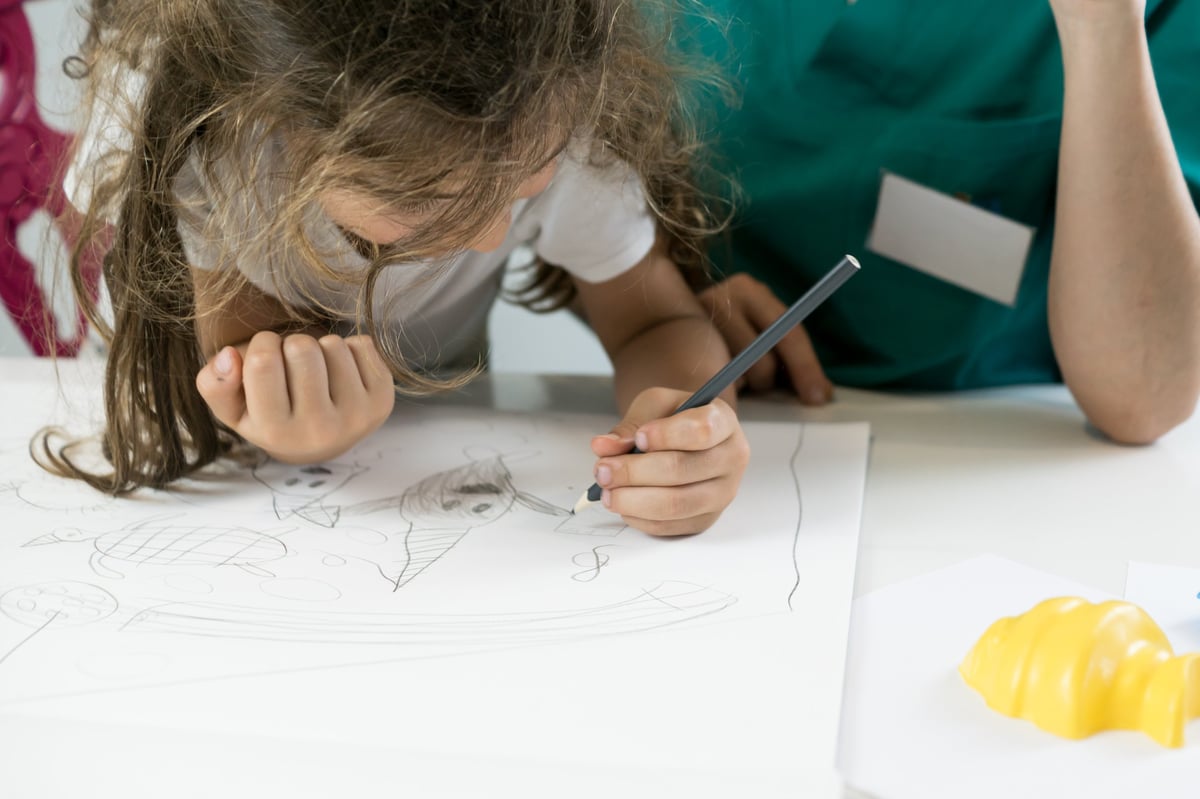
Handwriting pulls together more than most people realize. It needs shoulder stability to hold the arm steady, wrist control, a grip that can hold a pencil without gripping too hard, the ability to separate the fingers that move from the ones that hold, and the eye-hand coordination to place a letter where you meant to. On top of all that sits the brain's plan for the letter itself.
That is why a handwriting problem is often not a handwriting problem. A child who writes slowly and presses too hard may be working from a weak shoulder and core, not a weak hand. A child who cannot sit still to write may be seeking movement their body needs before it can settle. A child whose letters are all different sizes may be struggling with spatial awareness rather than effort.
Around kindergarten and first grade, writing demands jump sharply. Many children who seemed fine in preschool suddenly cannot keep up with the volume of written work. That is a hard experience for a child, because the message they take is “I am not smart,” when what is true is “my hand is not keeping up with my ideas yet.”
Occupational therapy for handwriting might look like obstacle courses and wheelbarrow walking, putty and tongs, drawing on a vertical surface with the arm up against gravity, and work on starting letters from the top. It might look like checking whether your child's feet reach the floor and whether their chair supports them, because a child who is holding themselves up with one hand is writing with the other.
It is worth saying that some children simply develop fine motor control later than their peers, and that homemade practice, a good pencil grip and a bit of patience are the whole answer. The sign that it might be more than that is when the gap between what your child can say and what they can write keeps growing, or when writing has become something they avoid and dread.
If school has raised handwriting, or you see your child avoiding the pencil at home, an occupational therapy evaluation will tell you whether it is a motor skill to build, a support to change, or simply time.
Try this at home
Try this today: check whether your child's feet are flat on the floor when they write. If they are dangling, put a box or a stack of books under them. A stable base sounds like a small thing and it changes how much of the arm and hand is available for the pencil.
Written by New Heights Therapy Occupational Therapy Team
Back to all articles